
Embedded Systems & Product Development Consultancy · London, UK
Embedded engineering for consumer and smart home products
At a million units, every design decision is multiplied: cost, power, test time and field returns. We have engineered a safety-critical consumer product built at that scale, and we bring the same discipline to connected products for the home.
What changes at a million units
A consumer product has to be cheap to build, simple to use and reliable in homes you’ll never see. Volume turns small decisions into large ones.
- A few pence on the bill of materials becomes a budget line.
- Test time per unit sets how many units the factory can ship.
- A firmware bug that slips through becomes thousands of returns.
- Batteries have to last for years in millions of homes.
- Mesh networks have to keep working with many devices and a crowded radio spectrum.
- Safety products have to meet their standards on every unit, not just the samples.
We design for volume from the start: for cost, for test and for the field.
What we build for consumer and smart home products
- Safety and alarm devices. Safety-critical firmware developed and unit-tested to IEC 61508.
- Thread, Zigbee and Bluetooth devices. Mesh and point-to-point connected products that join the home network and stay on it.
- Detection algorithms. Algorithms designed and simulated in 2D and 3D, then written in efficient C for the microcontroller.
- Battery-powered sensors. Multi-year battery life from careful hardware choices and firmware scheduling.
- App-connected products. Devices that pair with a phone app, sync reliably and update over the air.
- Custom silicon support. Firmware, testing and documentation alongside a silicon vendor developing a custom ASIC.
Engineering for volume
- Sensors & embedded algorithms: detection algorithms from simulation to fixed-point C on the target. →
- Functional safety: IEC 61508 development with LDRA for unit testing and code analysis. →
- Wireless & IoT: Thread on Silicon Labs EFR32, Zigbee, Bluetooth LE and Wi-Fi. →
- Low-power design: battery life planned, measured and protected in firmware. →
- Testing & verification: unit tests, Python-driven automated tests and code reviews. →
- Production readiness: production test that keeps up with volume lines. →
Hardware in shipped products
Client names stay private. The engineering doesn’t.

Detection algorithms and safety-critical firmware for a device manufactured at over a million units
Read the case study
Smart parking from sensor to cloud: nRF52840 firmware, Bluetooth mesh and Firebase
Read the case studyMore connected products
A low-power wearable with BLE, OTA and wireless charging, a secure NB-IoT sensor reporting to AWS IoT Core and more.
View case studiesFrequently asked consumer product questions
Can you help reduce our bill of materials?
Yes. We review the design for cheaper equivalent parts, functions that can move into firmware, and simpler power and radio choices, without trading away reliability or certification.
Which wireless technology should our product use?
It depends on range, power, the ecosystem it joins and the phone app. We have shipped Thread and worked with Zigbee, Bluetooth LE and Wi-Fi, and can recommend the right fit. Thread is also the network layer under Matter.
Do you design for production test?
Yes. Test points, test firmware and automated Python test scripts are planned in, so each unit is checked quickly and the same way.
Can you work with our app and cloud team?
Yes. We agree the BLE or network interface early, document it with sequence diagrams and work with your team through integration and updates.
Have you worked to safety standards on consumer products?
Yes. We contributed safety-critical firmware, developed to IEC 61508, to a consumer product manufactured at over a million units, using LDRA for unit testing and analysis.
Bringing a connected product to market?
Tell us what it does and how many you plan to build.
An engineer will read it and reply within one business day.
Latest from the blog
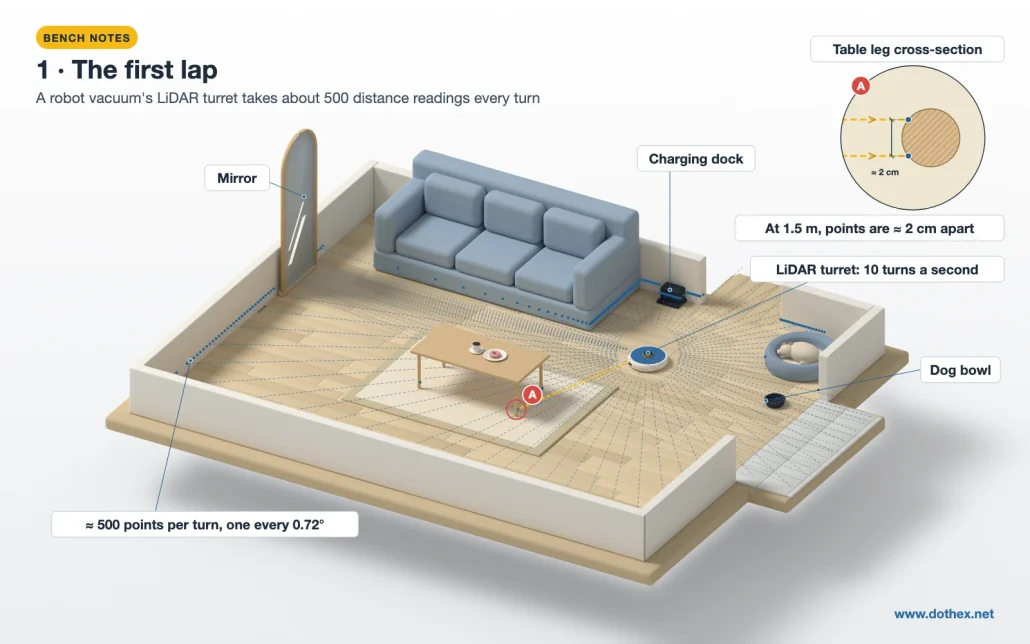
SLAM in a living room: how a robot vacuum builds a map
November 24, 2026
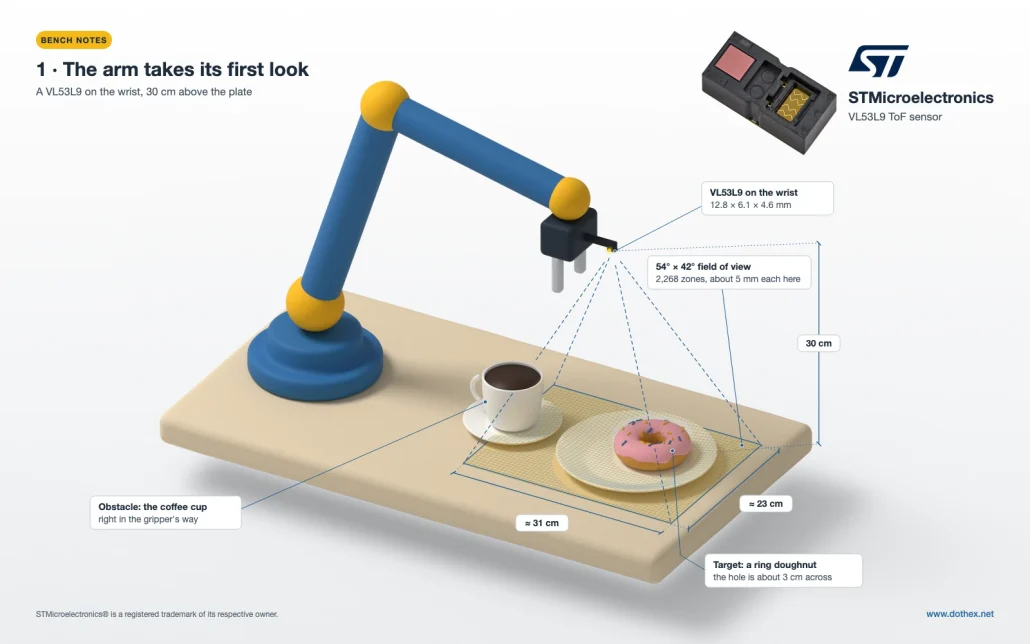
2.3K zones: what a robot sees in 3D with ST’s VL53L9
November 10, 2026

Ultra Low Power Microcontrollers: STM32L5 Series
March 7, 2020