
Embedded Systems & Product Development Consultancy · London, UK
Testing and verification
Firmware that hasn’t been tested on hardware isn’t finished. We build unit tests, hardware-in-the-loop rigs, production test jigs and the CI pipelines that run them, so every release is checked the same way.
Bugs that reach customers before testers
Embedded teams often test by hand, on one bench, just before a release. That finds some bugs, late and expensively.
- No unit tests, so every change risks breaking something nobody checks.
- Manual test runs that take days and get skipped under deadline pressure.
- Problems that only appear at low temperature, on a low battery or after days of running.
- Production units tested differently on every line, or not tested at all.
- Test results kept in spreadsheets, with no link to the firmware version.
- Field returns that can’t be reproduced in the lab.
We automate the checks that matter and run them on every build and every unit.
Test systems we build
- Unit testing. Unit tests for firmware modules on the host and on the target, with coverage reports, including LDRA for safety projects. →
- Hardware-in-the-loop rigs. Test rigs that drive inputs, simulate sensors and networks and check outputs on real hardware.
- Production test jigs. Fixtures with Python or C# software that program, test and calibrate each unit on the line. →
- Continuous integration. Builds, static analysis and tests on every commit, with release artefacts that can be traced.
- Environmental and long-run tests. Temperature, power and soak tests that find faults which only appear at the extremes or over time.
- Field and acceptance tests. Factory and site acceptance tests planned and supported with the customer.
Building a test strategy that lasts
- Decide what must never break. Safety functions, connectivity, power and the features customers notice first.
- Test at the right level. Unit tests for logic, hardware-in-the-loop tests for timing and interfaces, system tests for the whole product.
- Automate early. Scripts and rigs built alongside the firmware, so tests grow with the code.
- Connect tests to releases. Every test run tied to a firmware version and a board revision.
- Carry tests into production. The same checks, trimmed for speed, running on the production line.
Frameworks, rigs and pipelines
Unit test frameworks: Unity and CMock, GoogleTest, Ztest for Zephyr, LDRA tool suite
Automation: Python with pytest, C# and .NET test applications, YAML test definitions
CI and tooling: Git, GitHub Actions, GitLab CI, Jenkins, static analysis, code coverage
Test hardware: J-Link and ST-Link probes, logic analysers, programmable supplies, environmental chambers
Proof from the production line
Client names stay private. The engineering doesn’t.

Automated production testing that cut production time by 60% for an ATM security device
View case studies
More test work
Unit testing to IEC 61508 for a device built at over a million units, and Python test jigs for an industrial monitor taken through factory and site acceptance tests.
Ask about this workFrequently asked testing questions
Can you unit test firmware that talks to hardware?
Yes. We put hardware access behind thin interfaces, then test the logic on a PC with mocks and run the hardware-dependent parts on the target.
Can you add tests to an existing codebase?
Yes. We start with the riskiest modules and the bugs you’ve already had, add tests around them, and grow coverage as the code changes.
Do you build production test jigs?
Yes: the fixture, the test software and the operator interface, with results logged for every serial number. See production test jigs.
Which CI system do you use?
Whichever your team uses, such as GitHub Actions, GitLab CI or Jenkins. Pipelines build the firmware, run static analysis and tests, and keep the artefacts for each release.
What is hardware-in-the-loop testing?
Running the real firmware on the real board while a test rig plays the outside world: sensors, buttons, networks and power supplies. It catches timing and interface faults that unit tests can’t.
Do you test to safety standards?
Yes. For IEC 61508 projects we use the LDRA tool suite for unit testing, coverage and code review, and keep the records an assessor needs.
Want releases you can trust?
Tell us how you test today and what keeps going wrong.
An engineer will read it and reply within one business day.
Latest from the blog

Event Scope: EW – ELECTRONIC WARFARE EUROPE 2020
June 22, 2020
Event Scope: MICRO NANO MEMS 2020
June 8, 2020
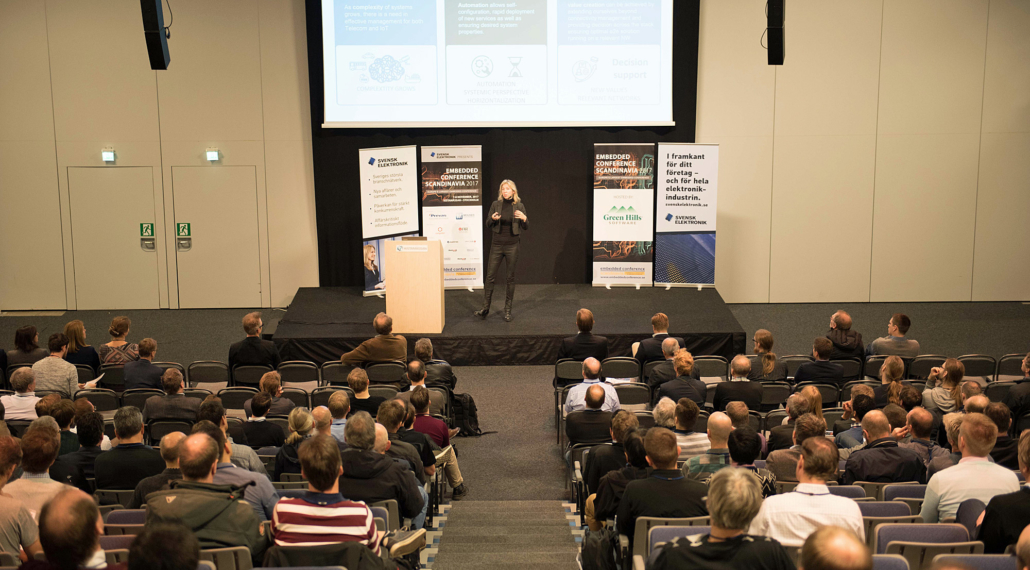
Event Scope: EMBEDDED CONFERENCE SCANDINAVIA 2020
May 29, 2020